The Driftwood Archive: Why Some Art Should Never See the Light
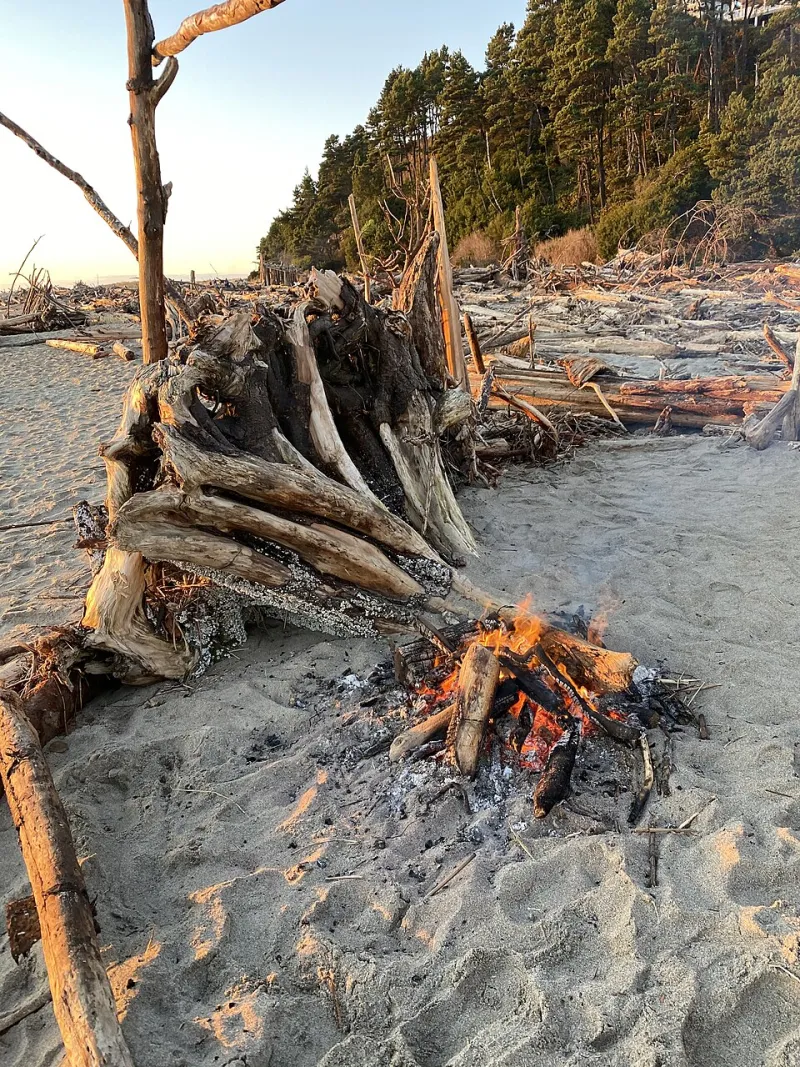
Photo: © 2021 Walker Webb Watson, CC BY-SA 4.0, via Wikimedia Commons
On my phone, wedged between a grocery list app and a weather radar, there's a folder called Driftwood. It's not a great name. It came to me at a beach rental in the Outer Banks a few years back, watching the tide push in pieces of wood that had clearly been traveling a long time—smoothed down, stripped of bark, useless for anything except being what they were.
That folder holds four hundred and twelve images. None of them will ever be posted.
What's in the Dark
There's a photo of a laundromat in Bisbee, Arizona, taken at golden hour, when the fluorescent tubes inside made the whole storefront glow like an aquarium. There's a sketch of my grandmother's hands that I abandoned halfway through the knuckles because I couldn't get them right. There are voice memos of me reading half-formed sentences out loud in the car—sentences that only made sense in that moment, on that stretch of I-80, somewhere between Lincoln and wherever I was going.
I started asking friends about their versions of this folder, and the responses came fast, almost guilty, like I'd caught them doing something. A guy I've known since college keeps a notes file of overheard conversation fragments. A coworker in Portland has been photographing abandoned shopping carts for six years—same cart, different parking lots, a series she calls (only to herself) Carts of the American West.
None of it is for sale. None of it has a strategy behind it. That's the whole point.
The Feed Is a Stage, and Stages Change How You Move
Here's what I've noticed about the work I share versus the work I keep: the moment something is destined for an audience, it starts behaving differently. I compose differently. I pick the shot that will read well at thumbnail size. I trim the paragraph to a length the algorithm supposedly likes. Even when I swear I'm not doing it, I'm doing it.
Psychologists call this audience effects—the measurable ways behavior changes when someone's watching. We've all felt it. Dance alone in your kitchen and then try the same dance when a roommate walks in. Different dance.
The feed, for all its connection, is fundamentally a stage. And stages require performance. What lives in the dark requires nothing. It doesn't need a caption. It doesn't need to be legible to anyone, including your future self.
Driftwood Doesn't Know It's Beautiful
The reason I love driftwood as a metaphor—the reason the folder keeps its bad name—is that driftwood has no audience. The ocean isn't sculpting it for likes. The sanding-down happens as a byproduct of the journey, not for display. It becomes beautiful because of what it went through, not because of who's watching.
That laundromat photo? I took it because the light did something to me. The sketch of my grandmother's hands? I started it because I missed her, and I quit it because some things resist being finished, and quitting it felt honest too. The voice memos from I-80 are essentially letters to no one.
There's a freedom in work that has no destination. You can't fail at it. You can't ruin it. There's no gap between the vision and the execution because the execution was always the point.
The Case for a Private Practice
I want to be careful here, because I'm not saying artists should hide their work, or that sharing is corrupt. Sharing is how I pay rent. Sharing is how any of us find each other. The attention economy gets a bad rap, but attention is also just another word for care.
What I'm arguing for is a protected reserve. A room no one else has the key to. Every creative person I admire has one. The novelist with the journal she'll burn before she dies. The painter who fills sketchbooks that stay shut. The photographer whose best work lives on a hard drive nobody's backed up, which is its own kind of privacy, albeit an accidental one.
These private practices do something the public work can't: they keep the well from running dry. When every photo is potential content and every sentence is potential copy, creativity starts to feel like farming—output, yield, harvest. The driftwood folder is fallow ground. It produces nothing. And paradoxically, it's where the best ideas come from, because nothing there is trying to be anything.
Keep Something Back
If you have a folder like mine, I'm not suggesting you post it. Please don't. Some of it might be genuinely good, and that's fine—goodness was never the measure. Let it stay smooth and strange and unpolished in its dark water.
And if you don't have one, consider starting. Take the photo and don't post it. Write the paragraph and close the file. Sketch badly and keep the sketch. Not to share later, not for a future project, not for any reason at all.
Just for the making. Just for the tide coming in, and something washing up, worn smooth, that belongs only to you.