Someone's Mother Wrote 'Milk' in the Rain: Notes From the Parking Lot Archive
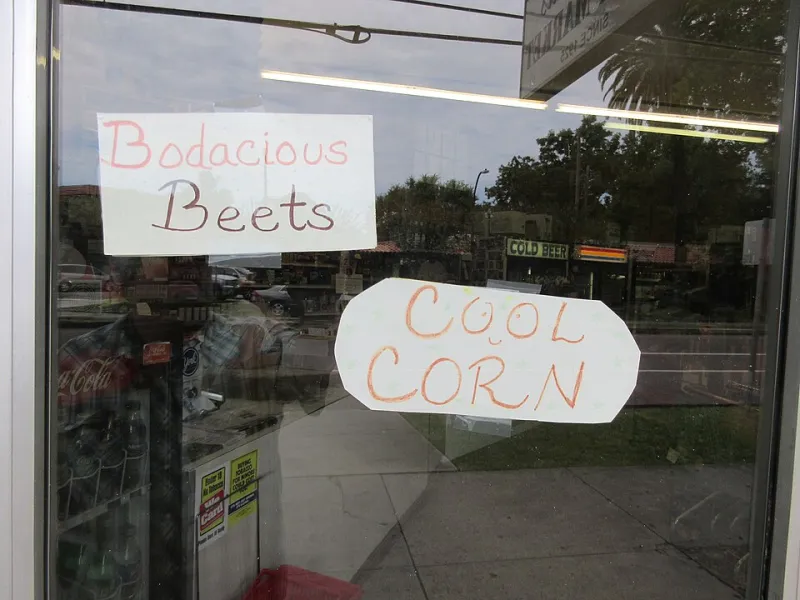
Photo: Infrogmation of New Orleans, CC BY-SA 4.0, via Wikimedia Commons
There's a list fluttering against the curb of a Kroger parking lot outside Columbus, and I almost drove over it before I saw the handwriting. Big, loopy, unhurried letters. Eggs. Bananas. Call Deb back.
That last one stopped me. Not the eggs. Not the bananas. Call Deb back.
We don't usually think of grocery lists as documents. They're tools — disposable, functional, meant to live for forty-five minutes and die in a cart basket or the bottom of a coat pocket. But pick one up off the asphalt, smooth it out on the hood of your car, and you're holding something closer to a diary entry than a reminder. It's a self-portrait drawn in ballpoint pen, made by someone who never sat for the portrait at all.
The Most Honest Genre We Have
Here's what makes a grocery list different from every other piece of writing in your life: you wrote it for an audience of one, and that one was a slightly dumber version of you. No posturing. No LinkedIn voice. No caption engineered for engagement. Just the raw inventory of a household on a Tuesday.
And because nobody's watching, the truth leaks out. You can tell a lot from the list that says cigarettes (LAST ONE I SWEAR) — the parenthetical is a negotiation, a treaty signed between a person and their own resolve. You can tell a lot from the list that spells out chocolate chips, the GOOD kind, not store brand — that's a person who has been burned before and carries the memory like a scar.
Lists are where we admit what we actually consume, what we're trying to quit, what we keep forgetting, and who we're feeding. They are, in their way, the most honest genre American letters has going.
What I've Found (and Kept)
I'll confess something that probably sounds stranger than it is: I've been rescuing lists for a few years now. Not hoarding — rescuing. A folder in a drawer, a shoebox's lesser cousin. Maybe two dozen scraps of paper, each one a small mystery with a plot you'll never learn.
There's the one written on the back of a church bulletin, seven items, all of them for someone else — grandma's prunes, the crossword puzzle book, stamps. There's the one in a child's handwriting, every letter carefully formed, that says mom sed hot dogs. There's the one with a phone number scribbled in the margin and the name "Mike??" next to it, a question mark doing the heavy lifting of an entire romantic history.
What gets me is the tenderness hiding in the mundane. A list that includes dog's allergy pills — do NOT forget again is a love letter. A list that says flowers (the yellow ones she likes) is a love letter. We write these things half-asleep, in line at a red light, standing in aisle seven realizing we left the list on the kitchen counter — and in doing so, we leave behind tiny records of who we're devoted to.
The Archaeology of Tuesday
Future archaeologists will have no shortage of monuments and official records to work from. What they won't have — what's already vanishing — is this: the paper list, written by hand, dropped in a parking lot.
The phone killed it, mostly. Shared Notes apps and Instacart orders don't blow across a Walmart lot at dusk. And I get it; I use them too. But something is lost when the list stops being an object. A shared digital cart can't tell you what kind of pen your mother used. It can't have a coffee ring stamped across the word butter. It can't survive long enough to become a stranger's small discovery on a windless afternoon.
The paper list was ephemeral on purpose, and its ephemerality was the point. It belonged to the world of receipts in old jacket pockets and ticket stubs in yearbooks — the accidental archive, the stuff that survives not because anyone meant to preserve it but because it slipped somewhere and stayed.
Read the Room, Read the Curb
I'm not asking you to start a collection. I'm asking something smaller: the next time you see a scrap of paper on the ground outside the store, look at it for two seconds before it goes in the trash or the storm drain. That's all.
Because whoever wrote it was doing something quietly remarkable. They were translating the chaotic, unspoken project of caring for a life — a partner, a kid, a dog, a body, themselves — into seven nouns and a verb. Eggs. Bananas. Call Deb back.
I hope Deb got called. I hope the eggs made it into the cart. I hope whoever wrote that list knows that a stranger once held it up to the light in a parking lot outside Columbus and thought, briefly, here is a whole person.
That's the thing about what we throw away. It never really asks to be seen. But it's worth seeing anyway — drifting down the aisle of an ordinary day, telling the truth about us in a way we never would on purpose.