The Tide Doesn't Rush: Notes on Writing from a Porch That Smells Like Brine
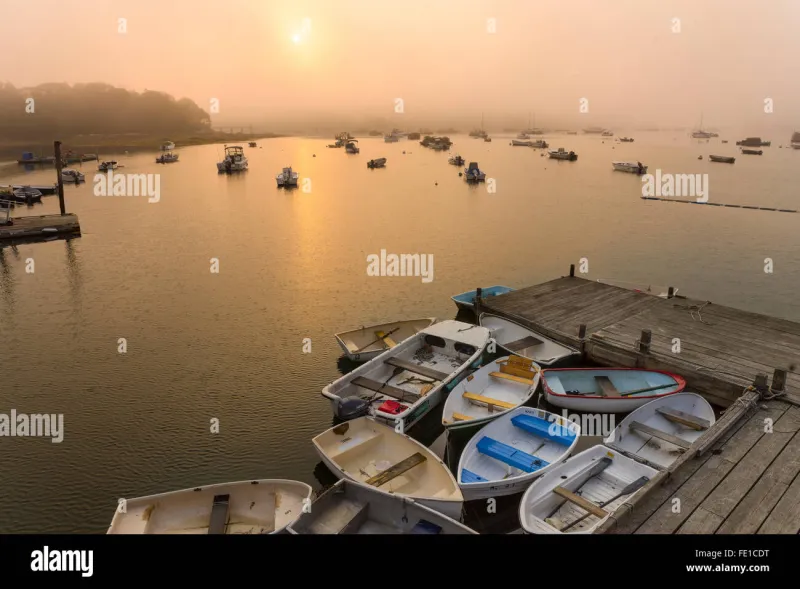
Photo: foggy Maine coastal harbor low tide wooden pier moody morning light, via c8.alamy.com
I moved to the Maine coast in October, which everyone told me was the wrong month. The tourists were gone, the lobster boats were getting pulled for the season, and the wind had a knife's edge to it. It was perfect. Nothing about that month performed for me, and that's exactly what my writing needed.
For years I had treated writing like a faucet — turn it on, expect water. The coast laughed at that logic. Out here, the water leaves twice a day, plain as anything, and nobody panics. The harbor goes to mud, the gulls stand around confused, the whole town shrugs. Then it comes back. The tide has never once felt guilty about ebbing.
I want to make an argument here, and I want to make it slowly: good writing behaves more like the sea than like a faucet. It requires ebb as much as flow. And most of us — especially those of us raised on American hustle mythology, on the idea that output equals worth — have never learned the ebb half of the craft.
What Low Tide Taught Me About Drafts
There's a mudflat near my house that reveals itself at low tide. Clammers come out with their rakes, bending over the wet sand like people praying. Everything they need was there all along; the water was just hiding it.
That's what my first drafts feel like from the other side. I used to think a rough draft was a failure of imagination. Now I think it's low tide — the water pulls back and shows you the flats. Some of what you find is a rusted can. Some of it is the thing you actually meant to say, sitting there in the muck, waiting for you to rake it up.
The mistake I made for a decade was writing at high tide only — waiting for inspiration, for the surge, for the muse to come in with the moon. The coast taught me to go out at low tide instead. To look at the ugly exposed bottom of a draft and trust that the mudflat is the work. Revision isn't the part after writing. On good days, revision is the writing.
Waiting Weather
People who don't live near the water don't understand waiting weather. It's the two or three days when the fog sits on the harbor like a wet blanket and every boat stays tied up. The fishermen don't fight it. They sharpen knives, mend traps, drink coffee, tell the same story about the storm of '91 with one new detail added each time.
I've started building waiting weather into my process. When an essay won't come, I don't wrestle it anymore. I put it in the fog bank. I mend something else — read an old book, take the long way to the post office, add one new detail to the story I've told a hundred times. Then, usually on the third day, the fog lifts on its own and the piece is sitting there with a shape I couldn't have forced.
There is a particular American guilt around this kind of idleness. We call it procrastination, writer's block, falling behind. But the boats stay tied up for a reason. Going out in fog is how you get killed. Forcing a piece before it's ready is how you get dishonest prose — the kind that sounds like a person arguing rather than a person telling the truth.
Salt Gets Into Everything
Here's the thing about salt air: it doesn't ask permission. It gets into your books, your jackets, the corners of your windows. After a year, everything you own smells faintly of the sea whether you like it or not.
Honest writing works the same way. You can't schedule authenticity for Tuesday mornings. It seeps in from the life you're actually living — the argument in the hardware store parking lot, the neighbor who lost her husband in the spring, the specific way light comes off the water at 4 p.m. in November. If you're not letting any of that into the ink, your pages will read like they were written in a vacuum-sealed room. Because they were.
The writers I admire most all have salt in their ink. It's not that they write about the ocean. It's that something real got into the paper and stayed. Joan Didion's dust. E.B. White's barn. Wendell Berry's Kentucky hills. None of it was decoration. All of it was weather.
The Return
Twice a day, the water comes back over the flats like it never left. Same harbor, same rocks — but never the same water, not once, not ever.
That's how I want to return to a manuscript. Not to the same draft I abandoned, but to the same draft made new by everything I've lived since. Distance isn't abandonment. Distance is the tide going out so you can finally see what you built on the seafloor.
So if your writing feels stuck, consider that maybe it isn't stuck. Maybe it's just out — pulled back to gather strength, the way water does, without apology and without hurry. Go look at the flats. Bring a rake. The good stuff was under there the whole time.